
How Much Does a Dehumidifier Cost to Run in the UK? (2026 Tariff Guide)
Most 12L–20L compressor dehumidifiers draw between 151 W and 330 W, which costs roughly 3.97p to 8.69p per hour at the Ofgem Q4 2026 Direct Debit electricity cap average of 26.32p/kWh. An 8-hour indoor drying cycle typically costs £0.32 to £0.69, far less than a 2,000 W fan heater or traditional vented tumble dryer.
Understanding what a dehumidifier actually adds to your electricity bill is often the difference between running it confidently through a damp British winter and leaving it unplugged in a cupboard while condensation builds on your windows.
Headline marketing labels rarely make the maths obvious. Two machines both badged as "20 litres per day" can differ by more than 200 watts in power draw, and UK electricity unit rates change every quarter under the Ofgem Energy Price Cap. Below, we walk through the exact formula, apply the live Q4 2026 Ofgem Direct Debit cap average of 26.32p/kWh (the default rate used by every calculator on this site), compare it with the announced Q1 2027 cap, and show real hourly and 8-hour cycle costs for models currently tracked on Amazon UK.
The Simple Running-Cost Formula (With 2026 UK Tariff Rates)
Every electrical appliance in Britain is billed by the kilowatt-hour (kWh). To find the cost of running a dehumidifier for one hour at full load:
Pence per hour = (Published wattage ÷ 1,000) × Unit rate (p/kWh)
To calculate an 8-hour overnight or indoor laundry drying session in pounds sterling:
8-hour cycle (£) = (Pence per hour × 8) ÷ 100
Which unit rate should you use?
- Ofgem Price Cap Q4 2026 (
26.32p/kWh) — site default: According to Ofgem's published cap figures for 1 October to 31 December 2026, the average Direct Debit default electricity unit rate across England, Scotland and Wales is 26.32p/kWh (with 0% VAT on domestic electricity between October 2026 and March 2027). Every interactive calculator on this site uses this rate by default, and every table includes an editable box so you can enter your exact supplier tariff. - Announced Q1 2027 Cap (
32.69p/kWh): Ofgem's unit-rate schedule for 1 January to 31 March 2027 lifts the average Direct Debit electricity rate to 32.69p/kWh. Fixed tariffs, regional distribution zones, prepayment meters, and multi-rate tariffs such as Economy 7 sit above or below these national averages, so always check your latest bill.
Notice that the daily standing charge (54.83p/day on average in Q4 2026) is paid regardless of whether you switch a dehumidifier on. Only the marginal unit rate determines what each extra hour of drying costs you.
Real Hourly and 8-Hour Cycle Costs Across Tracked UK Models
Using published manufacturer wattages from our verified dataset, the table below compares running costs across popular in-stock models at the current Ofgem Q4 2026 cap of 26.32p/kWh alongside the announced Q1 2027 average of 32.69p/kWh.
| Model | Type & Capacity | Published Power | Cost/hr @ 26.32p | 8h Cycle @ 26.32p | Cost/hr @ 32.69p | 8h Cycle @ 32.69p |
|---|---|---|---|---|---|---|
| MeacoDry Arete One 6L | Compressor (6L) | 101 W | 2.66p | £0.21 | 3.30p | £0.26 |
| MeacoDry Arete One 12L | Compressor (12L) | 151 W | 3.97p | £0.32 | 4.94p | £0.39 |
| MeacoDry Arete Two 12L | Compressor (12L) | 155 W | 4.08p | £0.33 | 5.07p | £0.41 |
| MeacoDry ABC 12L | Compressor (12L) | 165 W | 4.34p | £0.35 | 5.39p | £0.43 |
| Pro Breeze OmniDry 12L | Compressor (12L) | 200 W | 5.26p | £0.42 | 6.54p | £0.52 |
| EcoAir DC12 MK3 | Compressor (12L) | 210 W | 5.53p | £0.44 | 6.86p | £0.55 |
| MeacoDry Arete Two 20L | Compressor (20L) | 230 W | 6.05p | £0.48 | 7.52p | £0.60 |
| Meaco DD8L Pro | Desiccant (8L) | 231 W | 6.08p | £0.49 | 7.55p | £0.60 |
| De'Longhi AriaDry DEX214RF | Compressor (14L) | 300 W | 7.90p | £0.63 | 9.81p | £0.78 |
| Pro Breeze OmniDry 20L | Compressor (20L) | 330 W | 8.69p | £0.69 | 10.79p | £0.86 |
| Dimplex EverDri 20EL | Compressor (20L) | 390 W | 10.26p | £0.82 | 12.75p | £1.02 |
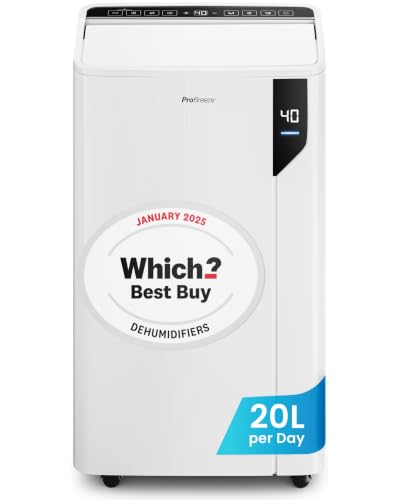
| Pro Breeze 20L Premium | Compressor (20L) | 440 W | 11.58p | £0.93 | 14.38p | £1.15 |
Swipe to see more columns
Two practical patterns jump out from these figures:
- Upfront ticket price vs 3-year energy spend: The Pro Breeze 20L Premium often sells for significantly less upfront than the MeacoDry Arete Two 20L, yet it draws 440 W compared with 230 W on the Arete Two 20L. At
26.32p/kWh, running the 440 W unit for 8 hours costs £0.93, compared with £0.48 for the 230 W machine. Across 120 winter drying sessions a year, that 210 W gap adds roughly £53.06 per winter at26.32p/kWh(or £65.90 at32.69p/kWh). - Why some desiccants omit a single wattage: Several EcoAir desiccant units (
DD1 Simple,DD1 Classic,DD1 Mini,DD2 Simple) use multi-stage heaters whose draw shifts between economy and turbo settings, so we leave their single wattage blank rather than guessing one number.
Why Published Wattage Is an Upper Ceiling, Not 24/7 Consumption
A common mistake when estimating monthly bills is multiplying full wattage by 24 hours a day for 30 days. In real British homes, a dehumidifier's humidistat acts as a thermostat for moisture:
- Initial drawdown: When you first switch a 12L or 20L unit on in a 70% RH Victorian hallway, the compressor runs continuously at full rated power for a few hours while pulling the air down towards 55% RH.
- Maintenance cycling: Once the target humidity is reached, the compressor shuts off. Depending on the model, the fan either switches off after a brief overrun or samples the air periodically at a fraction of compressor power until moisture rises again (after cooking, showering, or boiling the kettle).
- Laundry Mode exception: Selecting Laundry Mode intentionally overrides the target humidistat (or drops it to continuous operation) so the machine keeps extracting while wet clothes evaporate. That is why an 8-hour cycle calculation is the fairest way to budget for wash days.
Setting the target below 45% RH rarely brings extra comfort in a UK winter and forces the machine to work much harder for every extra millilitre of water, increasing runtime unnecessarily. For most heated homes, 50% to 55% RH prevents condensation without wasting electricity.
Compressor vs Desiccant: Temperature Changes Real Efficiency
Electricity cost per hour only tells half the story; what matters is pence per litre of water actually removed.
- Heated rooms (15°C to 22°C): Compressor dehumidifiers such as the Meaco Arete range or Pro Breeze OmniDry extract the most water per kilowatt-hour here. Note that minimum operating ratings vary—for example, the EcoAir DC12 MK3 lists a minimum temperature of 15°C, whereas Meaco Arete models are rated down to 5°C.
- Cold and unheated spaces (1°C to 10°C): Inside an unheated conservatory, garage, porch, or touring caravan, a compressor's cooling coils ice up frequently, triggering defrost cycles where electricity is spent melting frost rather than filling the tank. A desiccant model rated from 1°C (such as the Meaco DD8L Pro or EcoAir DD1/DD2 series) avoids coil icing and keeps extracting reliably, even though desiccants warm the exhaust air using a heater element.
Five Ways to Cut Your Dehumidifier Electricity Bill Without Losing Damp Control
- Keep doors and windows closed while running: As the Energy Saving Trust explains, opening trickle vents and purging stale air for five minutes a few times a day helps remove moisture naturally—just switch the dehumidifier off during open-window purging so you are not paying to dry outdoor air.
- Spin laundry thoroughly first: Every extra half-litre left in heavy jeans or bath towels after a slow spin cycle takes hours of electrical extraction indoors. Running your washing machine's highest appropriate spin speed before hanging clothes cuts dehumidifier hours dramatically.
- Clean the intake dust filter fortnightly: A dust-choked mesh filter starves airflow across the coils, forcing longer runtimes for the same litres extracted.
- Match tank size to your routine: If you dry large loads in a three-bedroom house, a 4.0L to 4.8L tank prevents the machine halting mid-session while you are at work or asleep.
- Pair with a £8–£17 hygrometer: Place a standalone digital hygrometer on the coldest external wall rather than trusting only the sensor built into the machine's housing. When the far corner holds 52% RH, you can safely step the dehumidifier down or rely on timed sessions.
Use the interactive tariff box below to recalculate any recommended in-stock model at your own supplier's unit rate, or open an individual tracker page to inspect its 8-hour and 30-day projections.
Recommended In-Stock Models & Running Costs
Only models currently in stock on Amazon UK are shown below. Adjust the electricity rate to match your tariff.
| Model | Category | Power | Cost / hr | 8h Cycle | Amazon UK Price | Action |
|---|---|---|---|---|---|---|
| Compressors | 101 W | 2.66p/hr | £0.21 |
£129.99
90-DAY LOW
Price accurate as of 29/11/2026 04:49 GMT
|
Check price on Amazon | |

Meaco MeacoDry Arete Two 12L Dehumidifier / Air Purifier
12L/day
·
35 dB
|
Compressors | 155 W | 4.08p/hr | £0.33 |
£199.99
90-DAY LOW
Price accurate as of 29/11/2026 04:49 GMT
|
Check price on Amazon |

Pro Breeze OmniDry 12L Quiet Dehumidifier with Max Extraction
12L/day
·
36 dB
|
Compressors | 200 W | 5.26p/hr | £0.42 |
£118.99
90-DAY LOW
Price accurate as of 29/11/2026 04:49 GMT
|
Check price on Amazon |
| Compressors | 440 W | 11.58p/hr | £0.93 |
£139.99
90-DAY LOW
Price accurate as of 29/11/2026 04:49 GMT
|
Check price on Amazon |

Product prices and availability are accurate as of the date/time indicated and are subject to change. Any price and availability information displayed on Amazon.co.uk at the time of purchase will apply to the purchase of this product.
Frequently Asked Questions
How do I calculate the exact running cost of my dehumidifier in the UK?
Divide the appliance's wattage by 1,000 to get kilowatts (kW), then multiply by your electricity unit rate in pence per kWh. For example, a 155 W unit draws 0.155 kW; at the Ofgem Q4 2026 cap of 26.32p/kWh that equals 4.08p per hour (or 5.07p per hour at the announced Q1 2027 average of 32.69p/kWh).
Does a dehumidifier use its full wattage all day and night?
No. Once the room drops to your target relative humidity (typically 50%–55% RH), the humidistat switches off the compressor or desiccant heater while either resting or periodically sampling the air with a low-wattage fan. Continuous draw only happens in Laundry Mode or until excess moisture is removed.
Why is a higher-wattage 20L dehumidifier sometimes cheaper overall than a cheaper 20L model?
Two 20L compressor units can differ sharply in power draw. In our UK dataset, the 230 W MeacoDry Arete Two 20L costs 6.05p/hour at the Ofgem Q4 2026 cap of 26.32p/kWh, whereas the 440 W Pro Breeze 20L Premium costs 11.58p/hour — nearly double per running hour if both run for the same length of time.
Are desiccant dehumidifiers always more expensive to run than compressors?
Per hour of active heating, desiccants typically draw more power than modern low-wattage compressors. However, in cold rooms below roughly 10°C—such as unheated conservatories or garages—compressors lose extraction efficiency and defrost frequently, whereas a 1°C-rated desiccant keeps removing water steadily.
More UK Damp & Running-Cost Guides
What Size Dehumidifier Do I Need? (6L vs 10L vs 12L vs 20L vs 25L UK Guide)
Size by bedrooms and dampness: Meaco's current guidance puts a 6L at one bedroom, a 10L at up to two, a 12L at up to three, a 20L at up to four and a 25L at up to five. Size up if you dry laundry indoors, have morning condensation or mould, or live in an older solid-wall home. Remember the litre figure is measured at 30°C and 80% RH, and Meaco's graph puts its 20L model at around 8 litres a day in average conditions.
Solid-Wall Victorian Terraces: Condensation vs Penetrating Damp Explained
In a solid-wall Victorian terrace, most damp is either condensation (moisture from cooking, washing and breathing settling on cold walls) or penetrating damp (rain getting in through gutters, downpipes or failed pointing). Historic England notes that rising damp is uncommon: a BRE analysis of 1,500 damp investigations found it in only 4% of cases. A dehumidifier helps with condensation and with drying out after repairs, but it cannot fix water coming in from outside.
What Is the Ideal Indoor Humidity in a UK Home? (40-60% RH Guide)
Aim to keep a UK home between 40% and 60% relative humidity, with around 50–55% as the everyday target Meaco recommends for British homes. If windows still stream on cold winter mornings, Meaco suggests lowering a dehumidifier's target towards 40% RH; readings that stay above 60% are where mould and dust mites thrive.