
What Size Dehumidifier Do I Need? (6L vs 10L vs 12L vs 20L vs 25L UK Guide)
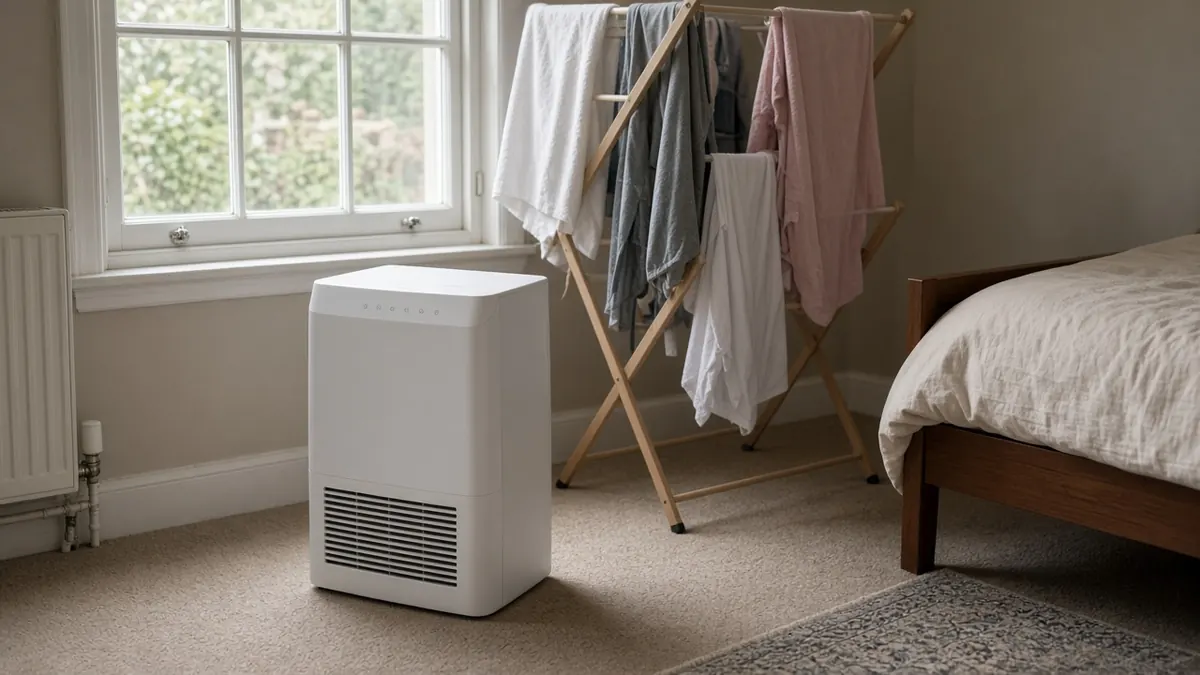
Size by bedrooms and dampness: Meaco's current guidance puts a 6L at one bedroom, a 10L at up to two, a 12L at up to three, a 20L at up to four and a 25L at up to five. Size up if you dry laundry indoors, have morning condensation or mould, or live in an older solid-wall home. Remember the litre figure is measured at 30°C and 80% RH, and Meaco's graph puts its 20L model at around 8 litres a day in average conditions.
Walk into any Amazon UK search for dehumidifiers and you face a wall of numbers: 6L, 10L, 12L, 16L, 20L, 25L. Buy too small and the machine runs flat out all winter without ever reaching its target. Buy far too big and you've paid for capacity you'll never use. This guide explains what those numbers mean and how to match one to your home.
It is about capacity. If you're still deciding between technologies, read our compressor vs desiccant guide first, because a compressor in a cold room will under-perform whatever its size.
What the Litre Number Actually Measures
The "L" on the box is litres of water extracted per day, but under laboratory conditions, not a British front room. Meaco explains that it rates every dehumidifier at 30°C and 80% RH, a benchmark that grew up in hot, humid markets such as Hong Kong, China, Japan and South Korea. It adds that some brands quote 32°C and 90% or 95% RH, which boosts their figures further (Meaco: Dehumidifier extraction rates compared).
Meaco says real European rooms are closer to 20°C and 60% RH, and a compressor's extraction falls as temperature and humidity drop. Its graph for its 20L model predicts around 8 litres a day in average conditions.
Two practical takeaways:
- Use the rating to compare models, not to predict your tank. A 20L unit removes much more than a 10L in the same room, but neither will hit its headline number in winter.
- Compare like with like. A model rated at 32°C/90% RH will look bigger on paper than one rated at 30°C/80% RH. Check the test conditions in the manual or specification sheet.
The Sizing Chart: Bedrooms and Dampness
Meaco's buying guide sizes dehumidifiers on two things: how many bedrooms the home has and how damp it is (Meaco: How to choose the best dehumidifier). Its chart, reproduced in summary:
| How damp is the home? | Up to 2-bed | Up to 3-bed | Up to 4-bed | Up to 5-bed |
|---|---|---|---|---|
| Slightly damp (50–60% RH; light mould or condensation) | 10L | 12L | 20L | 20L |
| Moderately damp (60–70% RH; musty smells, regular mould or condensation) | 12L | 12L | 20L | 25L |
| Very damp (70–80% RH; house always cold, mould and condensation in several rooms, drying washing) | 12L | 20L | 25L | 25L × 2 |
| Wet (80–100% RH; condensation on walls, mould on furniture or clothes, drying washing) | 20L | 20L | 25L × 2 | 25L × 2 |
To use it, you need a humidity reading. A hygrometer costing under £10 will give you one; our ideal humidity guide explains how to take readings that mean something.
Meaco's current product listings give simpler house-size labels for its Arete One range: 6L for one bedroom, 10L up to two, 12L up to three, 20L up to four and 25L up to five (Meaco: Arete One range). Those line up with the "slightly damp" row above. Meaco's help centre adds a general rule of 10–12 litres for flats and one- to two-bedroom homes, 12–20 litres for three- to four-bedroom family homes and 20–25 litres for larger homes or serious damp (Meaco Help Centre).
When to Size Up
Meaco's help centre lists four reasons to choose the next size up:
- You dry laundry indoors. A load of washing releases a lot of water into the air; our airer vs dehumidifier vs tumble dryer guide compares drying options.
- You see mould or condensation on the windows every morning.
- The house is older, with solid walls or poor ventilation. See our solid-wall Victorian terrace guide for why these homes behave differently.
- You want it to work quickly and quietly at a lower fan speed. A larger machine on a low setting can do the same job as a small one on high.
Two more considerations from Meaco's guidance: it recommends keeping internal doors open and windows closed for the best results, so the machine can work on more than one room, and in a cold space (below about 10°C) a desiccant is a better choice than any size of compressor.
Size Bands Explained
6L: one room or a one-bedroom flat
Meaco labels its compact Arete One 6L for a one-bedroom home. Treat a 6L as a single-room or small-flat machine: a bedroom, a box room or a studio. It isn't the answer for a whole house or for drying a family's washing.
10L: small flats and two-bedroom homes
The entry point for whole-home use in a small property that is only slightly damp.
12L: the typical three-bedroom semi
The most popular size, and the one Meaco rates for up to three bedrooms. It's also the sensible step up for a two-bedroom home that is moderately damp or dries washing indoors.
16L–20L: larger homes, laundry and damp older houses
Meaco rates its 20L units for up to four bedrooms. This is the band to look at if you dry washing indoors most days, live in a cold solid-wall house or have damp in several rooms.
25L and two units
At the top of Meaco's chart, very damp four- and five-bedroom homes call for a 25L or even two 25L machines. At that point, it is also worth finding out why the house is so damp.
In-Stock Models by Size
Amazon UK prices checked 28/11/2026 06:19 GMT. Running costs use the Ofgem cap of 26.32p/kWh for 1 October to 31 December 2026 (Ofgem) and are the cost while the unit is running at its listed wattage.
| Model | Rated L/day | Tank | Power | Noise | Cost per hour | 8 hours | Price |
|---|---|---|---|---|---|---|---|
| MeacoDry Arete One 6L | 6 | 1.8 L | 101 W | 32 dB | 2.66p | £0.21 | £129.99 |
| MeacoDry Arete Two 10L | 10 | 2.5 L | 152 W | 35 dB | 4.00p | £0.32 | £179.00 |
| MeacoDry Arete One 12L | 12 | 2.5 L | 151 W | 35 dB | 3.97p | £0.32 | £179.99 |
| Pro Breeze OmniDry 12L | 12 | 2.0 L | 200 W | 36 dB | 5.26p | £0.42 | £118.99 |
| MeacoDry Arete One 20L | 20 | 4.8 L | 216 W | 38 dB | 5.69p | £0.45 | £261.00 |
| Pro Breeze OmniDry 20L | 20 | 4.0 L | 330 W | 36 dB | 8.69p | £0.69 | £149.99 |
A few patterns stand out. Power draw doesn't scale neatly with capacity: the Arete One 12L and Arete Two 10L draw almost the same, and the Arete One 20L draws only 65 W more than its 12L sibling in our dataset. Bigger tanks also mean fewer trips to the sink, which matters if you're drying washing. For every model's running cost, see our running cost guide.
Tank Size Is Not Capacity
Meaco explains why a 20L dehumidifier doesn't have a 20 litre tank: the machine would have to be huge, and because one litre of water weighs one kilo, a full tank would be hard to lift. The tank tells you how often you'll empty it, nothing more. If you'll be away or are drying out after a leak, look for a model with continuous drainage.
Quick Picks by Home
- Studio or one-bedroom flat: 6L–10L; step up to 12L if laundry dries indoors. See our 1-bed flat picks.
- Two-bedroom terrace or flat: 10L if slightly damp, 12L if moderately damp.
- Three-bedroom semi: 12L as standard; 20L if very damp or drying washing daily. See our 3-bed semi picks.
- Four bedrooms or a damp older house: 20L, or 25L for a very damp home.
The Bottom Line
Count your bedrooms, take a humidity reading, and read across Meaco's chart. Then size up if you dry washing indoors, live in an older solid-wall home or wake up to wet windows. Ignore the idea that a 12L will fill its tank with 12 litres a day; that figure is a laboratory benchmark, and Meaco's own graph puts its 20L model at around 8 litres a day in average conditions.
Recommended In-Stock Models & Running Costs
Only models currently in stock on Amazon UK are shown below. Adjust the electricity rate to match your tariff.
| Model | Category | Power | Cost / hr | 8h Cycle | Amazon UK Price | Action |
|---|---|---|---|---|---|---|
| Compressors | 101 W | 2.66p/hr | £0.21 | £129.99 90-DAY LOW Price accurate as of 28/11/2026 06:19 GMT | Check price on Amazon | |

Meaco MeacoDry Arete Two 10L Dehumidifier / Air Purifier
10L/day
·
35 dB
|
Compressors | 152 W | 4.00p/hr | £0.32 | £179.00 90-DAY LOW Price accurate as of 28/11/2026 06:19 GMT | Check price on Amazon |

Meaco MeacoDry Arete One 12L Dehumidifier / Air Purifier
12L/day
·
35 dB
|
Compressors | 151 W | 3.97p/hr | £0.32 | £179.99 90-DAY LOW Price accurate as of 28/11/2026 06:19 GMT | Check price on Amazon |

Pro Breeze OmniDry 12L Quiet Dehumidifier with Max Extraction
12L/day
·
36 dB
|
Compressors | 200 W | 5.26p/hr | £0.42 | £118.99 90-DAY LOW Price accurate as of 28/11/2026 06:19 GMT | Check price on Amazon |

Meaco MeacoDry Arete One 20L Dehumidifier / Air Purifier
20L/day
·
38 dB
|
Compressors | 216 W | 5.69p/hr | £0.45 | £261.00 90-DAY LOW Price accurate as of 28/11/2026 06:19 GMT | Check price on Amazon |
| Compressors | 330 W | 8.69p/hr | £0.69 | £149.99 90-DAY LOW Price accurate as of 28/11/2026 06:19 GMT | Check price on Amazon |


Product prices and availability are accurate as of the date/time indicated and are subject to change. Any price and availability information displayed on Amazon.co.uk at the time of purchase will apply to the purchase of this product.
Frequently Asked Questions
Is a 10L dehumidifier big enough for a 3-bed house?
For a slightly damp home, possibly, but Meaco's current product guidance rates its 10L models for up to two bedrooms and its 12L models for up to three. If the house is moderately damp, you dry washing indoors or it has solid walls, a 12L or 20L is the safer choice.
Why does my 12L dehumidifier not collect 12 litres a day?
Because the rating is a maximum measured in hot, humid test conditions. Meaco rates its machines at 30°C and 80% RH and says real European rooms are closer to 20°C and 60% RH, where a compressor collects much less. Meaco's own graph for its 20L model predicts around 8 litres a day in average conditions.
Is it better to buy a bigger dehumidifier?
Often, yes, within reason. Meaco recommends choosing a size up if you dry laundry indoors, see condensation every morning, live in an older solid-wall home or want the unit to work quietly at a lower fan speed. A bigger unit costs more to buy, but on a humidistat it reaches the target sooner and then switches off.
Does the tank size matter?
It affects how often you empty it, not how much water the unit can remove. Meaco explains that tanks are smaller than the daily extraction figure because a 10 or 20 litre tank would make the machine huge and, at one kilo per litre, too heavy to lift. If you will not be around to empty it, look for continuous drainage.
More UK Damp & Running-Cost Guides
Solid-Wall Victorian Terraces: Condensation vs Penetrating Damp Explained
In a solid-wall Victorian terrace, most damp is either condensation (moisture from cooking, washing and breathing settling on cold walls) or penetrating damp (rain getting in through gutters, downpipes or failed pointing). Historic England notes that rising damp is uncommon: a BRE analysis of 1,500 damp investigations found it in only 4% of cases. A dehumidifier helps with condensation and with drying out after repairs, but it cannot fix water coming in from outside.
What Is the Ideal Indoor Humidity in a UK Home? (40-60% RH Guide)
Aim to keep a UK home between 40% and 60% relative humidity, with around 50–55% as the everyday target Meaco recommends for British homes. If windows still stream on cold winter mornings, Meaco suggests lowering a dehumidifier's target towards 40% RH; readings that stay above 60% are where mould and dust mites thrive.
How Often Should You Clean a Dehumidifier Filter (And What Happens If You Don't)?
Clean a dehumidifier's dust filter at least every two weeks: Meaco, Pro Breeze and EcoAir all give the same fortnightly interval, and Meaco says skipping it could invalidate the warranty. A clogged filter strains the fan motor, cuts the amount of water collected, raises energy use and can make the unit noisy or stop it collecting at all. HEPA and carbon filters are different and need replacing, not washing.