
What Is the Ideal Indoor Humidity in a UK Home? (40-60% RH Guide)
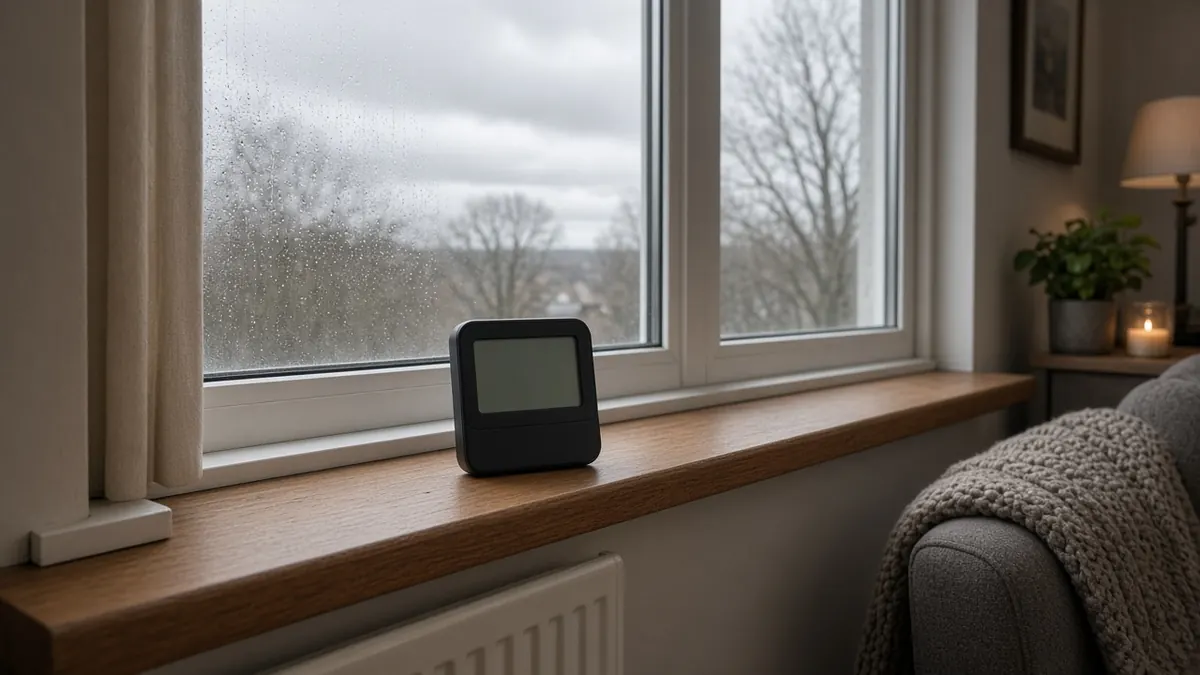
Aim to keep a UK home between 40% and 60% relative humidity, with around 50–55% as the everyday target Meaco recommends for British homes. If windows still stream on cold winter mornings, Meaco suggests lowering a dehumidifier's target towards 40% RH; readings that stay above 60% are where mould and dust mites thrive.
Most of us can tell when a room feels stuffy or a bedroom window is dripping, but very few people know what their indoor humidity actually is, let alone what it should be. A cheap hygrometer will give you a number in seconds. This guide explains what that number means, which range to aim for in a British home through the year, and how to use a dehumidifier's humidistat so you control damp without making the air uncomfortably dry.
If you want the physics of why water appears on cold glass, our dew point guide covers it in detail. Here we focus on targets and readings.
The Short Version: 40–60%, With 50–55% as the Sweet Spot
Relative humidity (RH) is the amount of water vapour in the air compared with the most the air could hold at that temperature. It is shown as a percentage on every hygrometer and dehumidifier display.
UK manufacturer guidance is consistent on the range:
- Meaco's help centre says indoor humidity is most comfortable and healthy between about 40% and 60%, and that mould and dust mites thrive above that (Meaco Dehumidifier Help Centre).
- For British homes specifically, Meaco says the optimum is 50–55% RH: dry enough to stop condensation, damp and mould, but not so dry that it causes itchy skin and sore throats. It recommends setting a dehumidifier to 55% as the general target (Meaco: How to use a dehumidifier).
So the practical rule is: keep the home inside 40–60%, aim for the middle, and pay attention when readings sit at the top end for days at a time.
What Each Reading Band Means
A single reading tells you little; a pattern tells you a lot. Use this as a rough interpretation chart. The upper bands follow Meaco's own descriptions from its dehumidifier sizing chart (Meaco: How to choose the best dehumidifier); the lower bands come from Meaco's comfort and cold-weather guidance.
| Reading that persists | What it usually means | What to do |
|---|---|---|
| Below 40% | Dry air; common during freezing spells | No dehumidifier needed; avoid over-drying |
| 40–50% | Comfortably dry; low condensation risk | Maintain |
| 50–55% | Meaco's recommended everyday target | Maintain; ideal humidistat setting |
| 55–60% | Upper end of the healthy range | Watch bedrooms and cold corners |
| 60–70% | "Moderately damp": musty smells, regular mould or condensation | Reduce moisture at source; dehumidify |
| 70–80% | "Very damp": mould and condensation in several rooms | Act now; look for a cause as well as a fix |
| 80–100% | "Wet": condensation on walls, mould on furniture or clothes | Treat as a building or leak problem until proved otherwise |
Spikes are normal. A bathroom will jump after a shower and a kitchen while pasta boils. What matters is how quickly the reading falls back once the extractor fan or window has done its job. A room that is still above 60% an hour later is telling you the moisture has nowhere to go.
A Season-by-Season Target Chart for British Homes
Relative humidity indoors swings with the weather outside, the heating and how much laundry is drying on the airer. These targets turn the general guidance into something you can set and forget.
| Time of year | Typical conditions | Suggested target | Why |
|---|---|---|---|
| Autumn (heating just on) | Mild, damp outdoor air; laundry moves indoors | 55% | Meaco's general target for UK homes |
| Mid-winter, mild and wet | Windows shut, heating on, washing indoors | 50–55% | Middle of the healthy range |
| Cold snaps with streaming windows | Very cold glass every morning | Towards 40–45% | Meaco suggests about 40% if 55% does not stop window condensation |
| Freezing, frosty spells | Outdoor air very dry | Leave the dehumidifier on its humidistat | Indoor RH often falls on its own |
| Spring and summer | Windows open more often | 55–60% | Ventilation does much of the work |
Why can freezing weather dry your home out? Meaco explains that when temperatures drop below zero, moisture gets locked up in ice and snow, and indoor relative humidity is often between 10% and 25% RH. Its dehumidifiers aim for 40–60% in humidistat mode and can only go to around 35% in laundry mode, so a machine that collects nothing during a hard frost is usually working perfectly (Meaco: Do dehumidifiers work in cold weather?).
How to Take Readings You Can Trust
Use a standalone hygrometer
GOV.UK guidance for landlords lists "consistently high relative humidity, as assessed using a moisture meter or environmental monitors" among the internal checks for damp, and notes that smart sensors can help monitor temperature and humidity (GOV.UK: Understanding and addressing the health risks of damp and mould in the home). You don't need anything elaborate. In-stock options in our dataset, with Amazon UK prices checked 28/11/2026 06:19 GMT:
| Hygrometer | Type | Price |
|---|---|---|
| ThermoPro TP50 | Basic display | £7.99 |
| Govee H5075 | Bluetooth, app history | £9.48 |
| SONOFF SNZB-02P | Zigbee smart sensor | £10.70 |
| Govee H5179 | Wi-Fi, app history | £16.99 |
A model that logs history is worth the extra pound or two: it shows overnight peaks you would never see by glancing at a screen at teatime. Our hygrometers page lists more.
Put it in the right place
- Away from obvious sources: not next to the kettle, the shower or a drying rack, unless you are deliberately measuring that spot.
- Away from the dehumidifier: the air coming out of it is drier than the rest of the room.
- In the room that worries you: usually the coldest bedroom, a north-facing room or the one with mould in the corner.
- At sitting or sleeping height: on a shelf or bedside table rather than on a radiator or windowsill.
Read it at the right times
Check first thing in the morning, when bedrooms are at their dampest after a night of breathing, and again in the evening. Note the room temperature too: 60% RH in a cold 14°C room is a bigger condensation risk on walls and glass than 60% in a warm 21°C living room, because the cold surfaces are closer to the dew point.
Don't rely on the dehumidifier's display
Meaco's managing director has explained that dehumidifiers deliberately do not try to be more accurate than ±5% RH, so they don't flick on and off when the room hovers around the target, and that a clean filter is needed for a reliable reading (Homebuilding & Renovating, quoting Meaco). Use the separate hygrometer as your reference.
Setting a Dehumidifier's Humidistat
Most modern dehumidifiers have a humidistat: you choose a target and the machine switches itself on and off to hold it. Meaco describes its own control logic like this: once the target (say 55%) is reached, the dehumidifier switches off, checks the air every 30 minutes and only restarts if humidity has risen by more than 5% (Meaco).
That has two practical consequences:
- Setting 40% "to be safe" is not free. The lower the target, the longer the machine runs. Start at 55% and only drop the target if your hygrometer and your windows say you need to.
- Continuous mode is for laundry or drying out, not everyday use. In normal use, let the humidistat do the work.
For a sense of cost, the MeacoDry Arete One 12L (£179.99, checked 28/11/2026 06:19 GMT) is listed at 151 W in our dataset. At the Ofgem cap of 26.32p/kWh for 1 October to 31 December 2026 (Ofgem), that works out at about 3.97p per hour while the compressor is running, or about £0.32 for eight hours. On a humidistat it will not run every hour. Our running cost guide compares every tracked model.
Room-by-Room Expectations
- Bedrooms: the most important room to log. Overnight readings tend to creep up with the door shut. If mornings regularly start above 60%, try leaving the door ajar or running a quiet dehumidifier on its humidistat; see our quiet bedroom picks.
- Bathrooms: expect short spikes. The test is recovery time with the extractor fan on and the door closed.
- Kitchens: lids on pans and the cooker hood on help more than anything you can buy.
- Living rooms: usually the warmest and driest room; a good baseline to compare others against.
- Rooms with laundry drying: readings can climb fast. A dehumidifier in laundry mode or a different drying method helps; our airer vs dehumidifier vs tumble dryer guide compares the options.
When the Number Is a Warning
Consistently high humidity is often a lifestyle and ventilation problem, but not always. If a room stays above 70% despite heating, ventilation and a dehumidifier, or one wall stays damp while the rest of the room is fine, look for a building defect such as a leaking gutter or pipe. GOV.UK guidance distinguishes condensation damp from penetrating, rising and traumatic damp, and each needs a different fix (GOV.UK).
Your readings are also useful evidence. If you rent, a dated log of high readings and photos of mould helps when you report the problem; our Awaab's Law guide explains what landlords must do. If mould has already appeared, follow our safe black mould cleaning guide before you start scrubbing.
The Bottom Line
Buy a hygrometer, put it in the room that worries you, and watch the pattern for a week. Aim for 40–60% with 50–55% as your everyday target, lower the dehumidifier towards 40% only when cold windows keep streaming, and treat readings that sit above 60% for days as a problem worth fixing rather than a number to live with.
Recommended In-Stock Models & Running Costs
Only models currently in stock on Amazon UK are shown below. Adjust the electricity rate to match your tariff.
| Model | Category | Power | Cost / hr | 8h Cycle | Amazon UK Price | Action |
|---|---|---|---|---|---|---|
| Hygrometers | — | — | — | £7.99 90-DAY LOW Price accurate as of 28/11/2026 06:19 GMT | Check price on Amazon | |
| Hygrometers | — | — | — | £9.48 90-DAY LOW Price accurate as of 28/11/2026 06:19 GMT | Check price on Amazon | |
| Hygrometers | — | — | — | £16.99 90-DAY LOW Price accurate as of 28/11/2026 06:19 GMT | Check price on Amazon | |
| Hygrometers | — | — | — | £10.70 90-DAY LOW Price accurate as of 28/11/2026 06:19 GMT | Check price on Amazon | |

Meaco MeacoDry Arete One 12L Dehumidifier / Air Purifier
12L/day
·
35 dB
|
Compressors | 151 W | 3.97p/hr | £0.32 | £179.99 90-DAY LOW Price accurate as of 28/11/2026 06:19 GMT | Check price on Amazon |


Product prices and availability are accurate as of the date/time indicated and are subject to change. Any price and availability information displayed on Amazon.co.uk at the time of purchase will apply to the purchase of this product.
Frequently Asked Questions
What humidity should my house be in winter?
Between 40% and 60% RH. Meaco's everyday target for UK homes is 50–55% RH, and it suggests dropping a dehumidifier's target to around 40% RH in colder months if condensation keeps forming on the windows.
Is 65% humidity too high indoors?
If it stays there, yes. Meaco puts the healthy range at about 40–60% and says mould and dust mites thrive above that. Meaco's own sizing chart describes 60–70% RH as 'moderately damp', typically with musty smells, regular mould or condensation. A short spike after a shower or cooking is normal; a reading that stays above 60% for days is the one to act on.
Can a home be too dry?
Yes. Meaco says pushing humidity much lower than the 50–55% range can cause dry, itchy skin and sore throats. In freezing weather, Meaco notes outdoor air is so dry that indoor relative humidity is often between 10% and 25%, which is why a dehumidifier may collect almost nothing during a cold snap.
How accurate is the humidity reading on my dehumidifier?
Treat it as a guide. Meaco's managing director has explained that dehumidifiers deliberately do not try to be more accurate than plus or minus 5% RH, to avoid switching on and off constantly. A separate hygrometer placed away from the dehumidifier gives a better picture of the whole room.
More UK Damp & Running-Cost Guides
What Size Dehumidifier Do I Need? (6L vs 10L vs 12L vs 20L vs 25L UK Guide)
Size by bedrooms and dampness: Meaco's current guidance puts a 6L at one bedroom, a 10L at up to two, a 12L at up to three, a 20L at up to four and a 25L at up to five. Size up if you dry laundry indoors, have morning condensation or mould, or live in an older solid-wall home. Remember the litre figure is measured at 30°C and 80% RH, and Meaco's graph puts its 20L model at around 8 litres a day in average conditions.
Solid-Wall Victorian Terraces: Condensation vs Penetrating Damp Explained
In a solid-wall Victorian terrace, most damp is either condensation (moisture from cooking, washing and breathing settling on cold walls) or penetrating damp (rain getting in through gutters, downpipes or failed pointing). Historic England notes that rising damp is uncommon: a BRE analysis of 1,500 damp investigations found it in only 4% of cases. A dehumidifier helps with condensation and with drying out after repairs, but it cannot fix water coming in from outside.
How Often Should You Clean a Dehumidifier Filter (And What Happens If You Don't)?
Clean a dehumidifier's dust filter at least every two weeks: Meaco, Pro Breeze and EcoAir all give the same fortnightly interval, and Meaco says skipping it could invalidate the warranty. A clogged filter strains the fan motor, cuts the amount of water collected, raises energy use and can make the unit noisy or stop it collecting at all. HEPA and carbon filters are different and need replacing, not washing.