
How Often Should You Clean a Dehumidifier Filter (And What Happens If You Don't)?
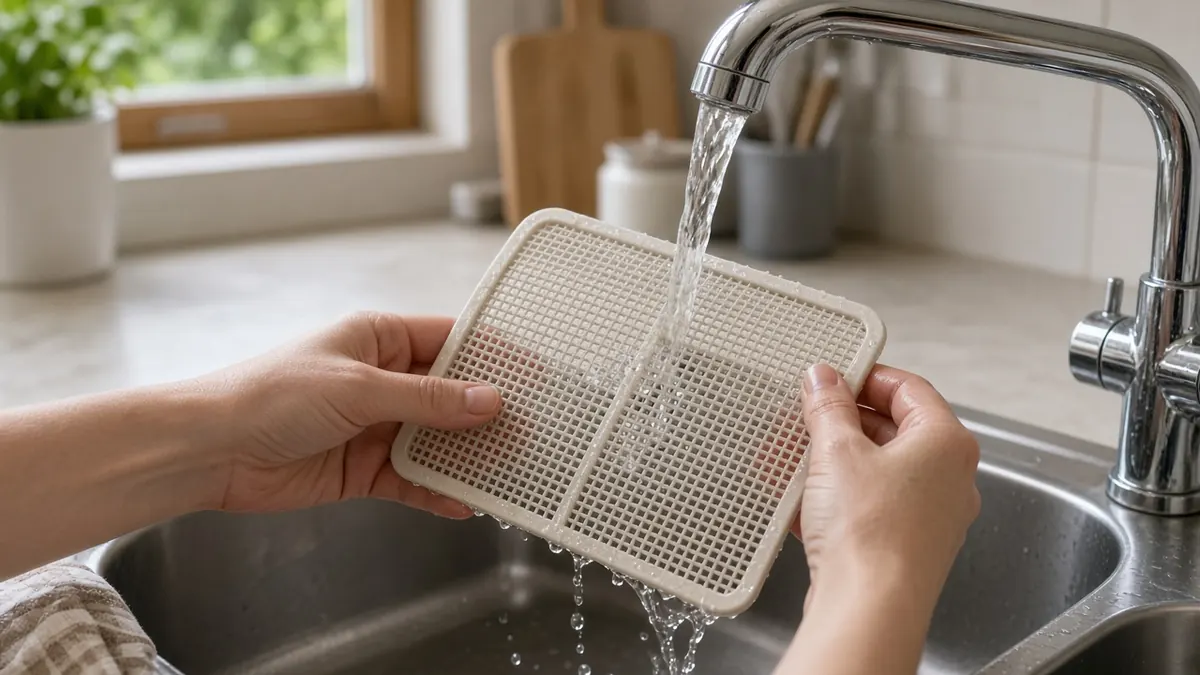
Clean a dehumidifier's dust filter at least every two weeks: Meaco, Pro Breeze and EcoAir all give the same fortnightly interval, and Meaco says skipping it could invalidate the warranty. A clogged filter strains the fan motor, cuts the amount of water collected, raises energy use and can make the unit noisy or stop it collecting at all. HEPA and carbon filters are different and need replacing, not washing.
A dehumidifier is one of the lowest-maintenance appliances in the house, which is exactly why the one job it does need gets forgotten. The dust filter on the air intake quietly fills up with fluff, pet hair and household dust until the machine is working harder for less water. This guide pulls together what UK manufacturers actually say about filter cleaning, explains what a dirty filter does to performance, and sets out a routine you can stick to.
The Answer: At Least Every Two Weeks
Three brands sold widely in the UK give the same interval:
| Manufacturer | How often | How to clean the dust filter | Source |
|---|---|---|---|
| Meaco | Minimum every two weeks; not doing so "could invalidate the unit's warranty" | Hoover it, or wash in soapy water no hotter than 40°C; rinse and dry completely | Meaco Help Centre |
| Pro Breeze | Every two weeks for optimal performance | Rinse under cool water; allow to air-dry completely | Pro Breeze support |
| EcoAir (DC12 MK3) | Every two weeks; "the frequency will depend on conditions of operation" | Brush or vacuum; do not wash, as washing weakens the filter's germicidal effect | EcoAir DC12 MK3 manual |
So the fortnightly rule is universal, but the method isn't. Washing an EcoAir mesh filter is exactly what its manual tells you not to do, while a Meaco or Pro Breeze filter can go under the tap. Check the manual for your own model before you reach for the washing-up liquid.
Meaco describes its dust filters as life-long: they should only need replacing for wear and tear. EcoAir, by contrast, recommends replacing the DC12 MK3's outer filter every six months for optimal performance and hygiene.
What Actually Happens If You Don't
The manufacturers are unusually blunt about this.
- More strain, less water, higher bills. Meaco's manual for its 12L and 20L Low Energy models says that if dust builds up on the filter, pressure on the fan motor increases and the amount of water extracted falls. It adds that not cleaning the filter "reduces the lifespan of the dehumidifier, increases energy consumption and decreases water extraction" (Meaco 12L/20L Low Energy manual).
- An empty tank, or a noisy one. Meaco's guide to the MeacoDry ABC filter lists the common problems a dirty filter causes: the unit not collecting water, the unit running but barely lowering humidity, or a noisy dehumidifier (Meaco blog: cleaning your MeacoDry ABC filter).
- Overheating and faults. EcoAir's safety notes say the filter must be cleaned every two weeks "to avoid dust building up internally causing overheating and malfunction".
- Warranty risk. Meaco is explicit that skipping fortnightly cleaning could invalidate the warranty.
- Less reliable readings. Meaco's managing director has said that a dehumidifier gives a reliable room humidity reading as long as the filter is kept clean (Homebuilding & Renovating, quoting Meaco).
The energy point matters more than it sounds. A machine with a choked intake runs longer to reach its humidity target, so every extra hour counts. For example, the Pro Breeze OmniDry 12L is listed at 200 W in our dataset, which is about 5.26p per hour at the Ofgem cap of 26.32p/kWh for 1 October to 31 December 2026 (Ofgem). Our running cost guide has the figures for every tracked model.
Dust Filters vs HEPA vs Carbon: Know Which One You Have
Not every filter in a dehumidifier is the same, and mixing up the care instructions can ruin one.
Washable dust filter (every model)
This is the mesh on the air inlet. Meaco's help centre explains that its job is to protect the machine, not to clean the air you breathe. It is the one that needs the fortnightly clean.
H13 HEPA filter (some models)
Meaco fits optional H13 HEPA filters to its Arete and Low Energy ranges. Its manuals say they are not life-long: replace them when the colour changes from white to grey, which Meaco puts at roughly every three months depending on the environment. You can hoover them occasionally in between. The Arete Two 20L/25L manual also notes that running without the HEPA filter reduces noise by 4–5 decibels, though the machine then dehumidifies only (Meaco Arete Two 20L/25L manual).
Carbon (charcoal) filter (optional extra)
Meaco says activated carbon filters trap smells and gases rather than particles. EcoAir sells an optional carbon filter for the DC12 MK3 and warns not to clean it with water.
A Fortnightly Routine That Takes Five Minutes
- Switch off and unplug. EcoAir recommends turning the unit off and waiting five minutes before unplugging. Meaco says to always unplug before cleaning and never spray the unit with water.
- Empty the tank first. On Pro Breeze models you remove the water tank to reach the filter.
- Remove the dust filter. On Meaco Arete models it slides out with the filter case; on Pro Breeze models you pull down on the handle.
- Clean it the way your manual says. Vacuum or brush for EcoAir; vacuum or soapy water (up to 40°C) for Meaco; cool running water for Pro Breeze.
- Dry it completely. Never refit a wet filter.
- Wipe the casing. A soft, dry cloth, or slightly damp if very dirty.
- Check the HEPA filter colour if your model has one, and note when it was last changed.
A recurring phone reminder on the 1st and 15th of each month is the easiest way to keep on schedule. During the heaviest season, when washing is drying indoors every day, check it weekly; EcoAir is clear that the right frequency depends on conditions.
The Rest of the Maintenance Checklist
The water tank
Pro Breeze recommends cleaning the tank with warm tap water and a mild detergent, never boiling water, scrubbing away any scale and drying it before refitting. EcoAir warns to take care not to damage the float when cleaning the tank.
Mould inside the machine
Meaco says mould inside a dehumidifier is usually environmental: the unit draws in whatever spores and dust are in the room. Its advice is to keep the surrounding area clean, clean the filter regularly and keep good airflow around the unit.
Putting it away for summer
Meaco says to clear moisture from the coils before storing a dehumidifier by running it in fan or air purification mode for at least eight hours. EcoAir's storage steps are to unplug, leave the unit to drain for about a day, clean and dry the tank, clean the filter, cover it to keep dust out and store it upright in a cool, dry place out of direct sunlight.
Quick Troubleshooting
| Symptom | Check first | Then check |
|---|---|---|
| Not collecting water | Dust filter | Target humidity already reached; room very cold or dry; tank seated properly |
| Louder than usual | Dust filter | Unit on a flat, even surface; nothing blocking the outlet |
| Tank-full light on with an empty tank | Tank seated and float in position | Manual's troubleshooting table |
| Collects nothing in a frost | Nothing; the air is simply dry | See our ideal humidity guide |
| Struggles in a cold room | Room temperature | Our compressor vs desiccant guide |
The EcoAir manual also notes a protective delay: after being switched back on, its compressor may not start dehumidifying for three minutes. That isn't a fault.
Models in Our Dataset and Their Filter Care
All in stock on Amazon UK, prices checked 28/11/2026 06:19 GMT:
| Model | Filter care per manufacturer | Power | Price |
|---|---|---|---|
| MeacoDry ABC 12L | Life-long filter; hoover or warm soapy water, minimum every two weeks | 165 W | £119.99 |
| MeacoDry Arete Two 12L | Dust filter fortnightly; H13 HEPA replaced when grey | 155 W | £199.99 |
| Pro Breeze OmniDry 12L | Rinse under cool water every two weeks | 200 W | £118.99 |
| EcoAir DC12 MK3 | Brush or vacuum only, every two weeks; outer filter replaced every six months | 210 W | £119.00 |
If you are drying laundry indoors, the filter clogs faster with lint; our indoor drying picks list models with laundry modes.
The Bottom Line
Clean the dust filter every two weeks, more often in dusty or laundry-heavy homes, using the method your manual specifies. Replace HEPA filters when they go grey rather than washing them. It is five minutes' work that protects the warranty, keeps running costs down and stops the most common reason a dehumidifier "suddenly stops working".
Recommended In-Stock Models & Running Costs
Only models currently in stock on Amazon UK are shown below. Adjust the electricity rate to match your tariff.
| Model | Category | Power | Cost / hr | 8h Cycle | Amazon UK Price | Action |
|---|---|---|---|---|---|---|

Meaco MeacoDry ABC 12L Dehumidifier
12L/day
·
36 dB
|
Compressors | 165 W | 4.34p/hr | £0.35 | £119.99 90-DAY LOW Price accurate as of 28/11/2026 06:19 GMT | Check price on Amazon |

Meaco MeacoDry Arete Two 12L Dehumidifier / Air Purifier
12L/day
·
35 dB
|
Compressors | 155 W | 4.08p/hr | £0.33 | £199.99 90-DAY LOW Price accurate as of 28/11/2026 06:19 GMT | Check price on Amazon |

Pro Breeze OmniDry 12L Quiet Dehumidifier with Max Extraction
12L/day
·
36 dB
|
Compressors | 200 W | 5.26p/hr | £0.42 | £118.99 90-DAY LOW Price accurate as of 28/11/2026 06:19 GMT | Check price on Amazon |

EcoAir DC12 MK3
12L/day
·
39 dB
|
Compressors | 210 W | 5.53p/hr | £0.44 | £119.00 90-DAY LOW Price accurate as of 28/11/2026 06:19 GMT | Check price on Amazon |
Product prices and availability are accurate as of the date/time indicated and are subject to change. Any price and availability information displayed on Amazon.co.uk at the time of purchase will apply to the purchase of this product.
Frequently Asked Questions
How often should I clean my dehumidifier filter?
At least every two weeks. Meaco, Pro Breeze and EcoAir all recommend a fortnightly clean, and Meaco states that not doing so could invalidate the unit's warranty. EcoAir adds that the right frequency depends on operating conditions, so dusty homes or homes with pets may need it more often.
Can I wash a dehumidifier filter with water?
It depends on the model. Meaco says its dust filters can be hoovered or washed in soapy water no hotter than 40°C, and Pro Breeze says to rinse under cool water and air-dry. EcoAir's DC12 MK3 manual says to clean the filter with a brush or vacuum because washing weakens its germicidal effect. Always check your own manual.
Why has my dehumidifier stopped collecting water?
A dirty filter is one common cause: Meaco says a clogged filter can stop the unit collecting water or leave very little in the tank. Other causes listed in EcoAir's troubleshooting table include the target humidity already being reached, the room being very cold or very dry, or the tank not being seated properly.
Do HEPA filters need replacing?
Yes. Meaco says the H13 HEPA filters in its Arete and Low Energy models are not life-long and should be replaced when they turn from white to grey, roughly every three months depending on conditions. They can be hoovered in between but should not be washed.
More UK Damp & Running-Cost Guides
What Size Dehumidifier Do I Need? (6L vs 10L vs 12L vs 20L vs 25L UK Guide)
Size by bedrooms and dampness: Meaco's current guidance puts a 6L at one bedroom, a 10L at up to two, a 12L at up to three, a 20L at up to four and a 25L at up to five. Size up if you dry laundry indoors, have morning condensation or mould, or live in an older solid-wall home. Remember the litre figure is measured at 30°C and 80% RH, and Meaco's graph puts its 20L model at around 8 litres a day in average conditions.
Solid-Wall Victorian Terraces: Condensation vs Penetrating Damp Explained
In a solid-wall Victorian terrace, most damp is either condensation (moisture from cooking, washing and breathing settling on cold walls) or penetrating damp (rain getting in through gutters, downpipes or failed pointing). Historic England notes that rising damp is uncommon: a BRE analysis of 1,500 damp investigations found it in only 4% of cases. A dehumidifier helps with condensation and with drying out after repairs, but it cannot fix water coming in from outside.
What Is the Ideal Indoor Humidity in a UK Home? (40-60% RH Guide)
Aim to keep a UK home between 40% and 60% relative humidity, with around 50–55% as the everyday target Meaco recommends for British homes. If windows still stream on cold winter mornings, Meaco suggests lowering a dehumidifier's target towards 40% RH; readings that stay above 60% are where mould and dust mites thrive.