
Should You Leave Window Trickle Vents Open All Winter in the UK?
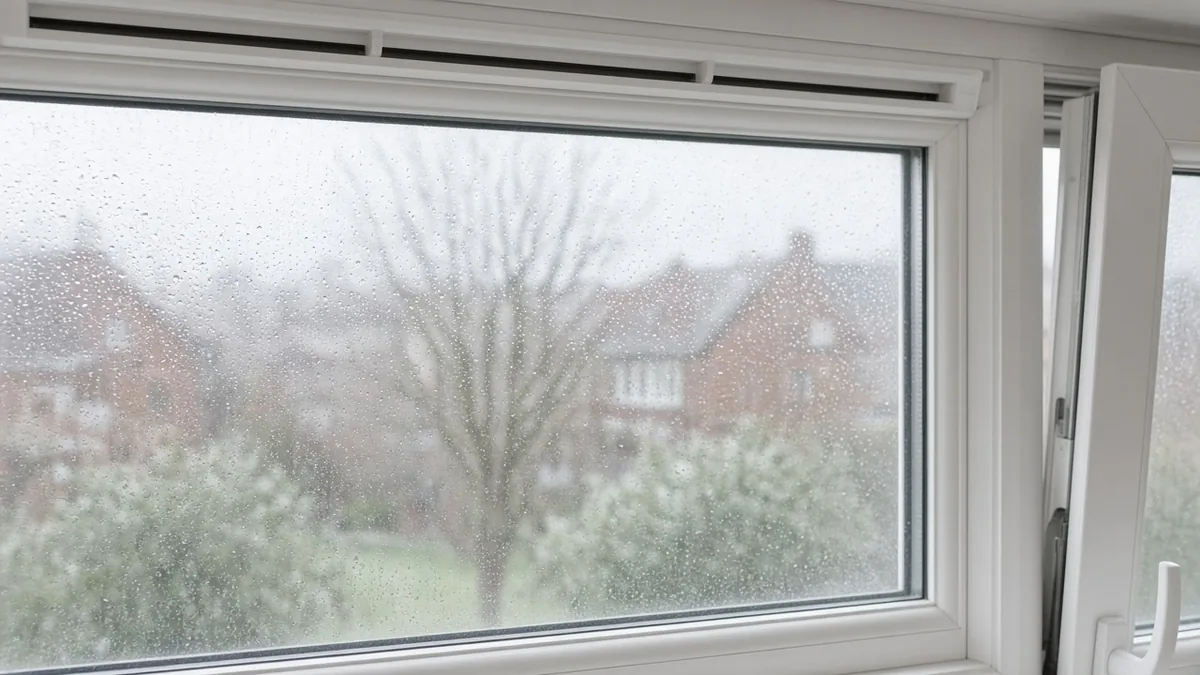
Yes. GOV.UK's ventilation guide and the Energy Saving Trust both say to keep trickle vents open and unblocked all year, including winter: you use a little more heating energy, but you get a constant, controlled supply of fresh air that carries moisture out before it condenses. Close them only briefly, for example when outdoor pollution or smoke is high, and reopen them afterwards.
Trickle vents are the narrow slotted strips along the top of most modern uPVC and timber windows. Come November, a lot of them get snapped shut: they whistle in the wind, the room feels a bit cooler, and it seems wasteful to heat air that is leaking straight out. Then the condensation starts. This guide sets out what official UK guidance actually says, why the draught worry is mostly a myth, the handful of times it makes sense to close them, and how to prove the effect in your own home with a £10 hygrometer.
The Short Answer From Official Guidance
The main UK sources say the same thing:
| Source | What it says |
|---|---|
| GOV.UK existing home ventilation guide | "Always leave trickle vents open and unblocked, even in winter. You will use a little more energy to heat your home, but have fresh air to prevent illnesses." |
| Energy Saving Trust | "Generally, you should keep trickle vents open all the time, even during the winter", to provide "a constant and controlled supply of fresh air". |
| Approved Document F, 2026 edition | "Background ventilators are intended to be left open." |
| NHBC Foundation, Moisture in New Homes | If you have trickle vents, check that they are always open. |
Swipe to see more columns
The government's damp and mould guidance for landlords includes "Do windows have trickle vents and are these kept open and free from blockages?" in its checklist (GOV.UK).
Why They Matter More in Winter, Not Less
A typical home generates moisture all day from breathing, cooking, showering and washing. GOV.UK's ventilation guide explains that without effective ventilation, this moisture is trapped and turns into condensation, "particularly in the winter when surfaces such as walls are cold".
Winter is exactly when the other ventilation routes shut down. Windows stay closed, people dry washing indoors, and bedrooms are sealed for eight hours with people breathing in them. Trickle vents are the one route that keeps working without anyone remembering to open anything. Close them and moist air has nowhere to go except onto the coldest glass and wall surfaces. Our guide to why condensation forms on the inside of windows explains the dew point physics.
This matters most in well-sealed homes. GOV.UK notes that when windows are replaced, the gaps and cracks that once let air in are sealed up, and in older homes those leaks "may have been the only source of ventilation". That is why new windows should come with trickle vents, and why closing them can leave a refurbished flat far more airtight than it ever was. New-build owners face the same issue; see our new-build drying-out guide.
The Draught and Heat-Loss Worries
"They make the room cold"
Trickle vents are deliberately small and deliberately high. The 2026 edition of Approved Document F (the Building Regulations guidance for England, taking effect for most building work on 24 March 2027) says background ventilators should be at least 1,700 mm above floor level "to reduce cold draughts, but still be easy for the occupant to reach". Incoming air mixes with warm room air near the ceiling rather than pouring across your ankles.
If a vent genuinely whistles or blasts cold air, the vent or its seal may be faulty, and that is worth fixing rather than living with permanently shut.
"I'm paying to heat air that leaves"
You are, a little. GOV.UK says so plainly. But the Energy Saving Trust points out that most of a home's heat is stored in the structure itself, so the air warms up again quickly. The alternative cost is condensation, damp and mould. The charity Groundwork notes that moist air costs more to heat, and the health risks of damp and mould are well documented.
"It's noisy outside"
The Energy Saving Trust suggests acoustic trickle vents with added soundproofing. Approved Document F says a noise-attenuating background ventilator should be fitted where a façade is close to sustained loud noise such as a main road.
When It Is Reasonable to Close Them
The guidance allows short-term closing, not seasonal closing:
- High outdoor pollution or smoke. The Energy Saving Trust says you can close them "for a little bit" when traffic or smoke pollution is high, then reopen once it has passed.
- A storm-driven draught. Close during a gale if you must, and reopen when it passes.
- A whole-house mechanical system. The Energy Saving Trust notes its recommendations might not apply if you have a mechanical system that continuously supplies and extracts air. Follow the system's instructions or ask your installer.
Three Things That Quietly Block Them
- Curtains and blinds. The Energy Saving Trust notes that closed curtains or blinds can make window trickle vents less effective. Leave a gap at the top, or use shorter curtains or blinds that sit inside the reveal.
- Paint, dust and dead flies. Slide the vent fully open and closed a few times and vacuum the slots. A vent that's open but clogged does nothing.
- Internal doors. GOV.UK suggests leaving doors between rooms open where possible to allow cross-ventilation. The exception is the kitchen or bathroom while cooking or showering, when moisture should be kept in that room and extracted.
Test It Yourself With a Hygrometer
Official advice is consistent, but seeing it in your own readings is more persuasive. A simple two-week experiment:
- Put a digital hygrometer in the bedroom that suffers most, away from the window and radiator.
- Week one: keep the habits you have now. Each morning, note the humidity, the temperature, and whether the window is wet.
- Week two: keep every trickle vent open day and night, with curtains clear of the vents. Record the same three things.
- Compare. Morning readings that drop back towards the 40–60% band and windows that need less wiping show the vents are doing their job.
Outdoor weather changes from week to week, so treat the result as a guide rather than a lab test. A Wi-Fi or Bluetooth model that logs readings saves you writing anything down.
| Hygrometer | Connectivity | Price on Amazon UK |
|---|---|---|
| ThermoPro TP50 | Display only | £7.99 |
| Govee H5075 | Bluetooth | £9.48 |
| Govee H5179 | Wi-Fi | £16.99 |
Swipe to see more columns
Price accurate as of 29/11/2026 06:23 GMT. Our ideal indoor humidity chart explains what each reading means.
Trickle Vents Are Background Ventilation, Not the Whole Plan
Trickle vents provide a steady trickle, as the name suggests. They are not designed to clear a steamy bathroom or a kitchen full of pasta water. The Energy Saving Trust's wider routine is:
- Keep trickle vents open all the time.
- Open windows for at least five minutes, two or three times a day, ideally on different sides of the home; in winter, favour the sunnier side.
- Run extractor fans when cooking or showering, and for at least 15 minutes afterwards (Energy Saving Trust).
If windows still run with water every morning, wipe them so the water does not soak into frames and sills. A window vac such as the Kärcher WV 1 (£24.99 at the time of checking) collects it quickly. Persistent high readings with good ventilation habits point to a bigger moisture source, and a dehumidifier may be needed; our sizing guide helps you choose one for a one-bed flat or larger home.
The Bottom Line
Leave your trickle vents open all winter. GOV.UK, the Energy Saving Trust, the Building Regulations guidance and NHBC agree: the small heat cost buys a constant flow of fresh air that carries moisture out before it becomes condensation and mould. Close them only briefly for pollution or a storm, keep curtains and dust clear of them, and use a hygrometer to see the difference for yourself.
Recommended In-Stock Models & Running Costs
Only models currently in stock on Amazon UK are shown below. Adjust the electricity rate to match your tariff.
| Model | Category | Power | Cost / hr | 8h Cycle | Amazon UK Price | Action |
|---|---|---|---|---|---|---|
| Hygrometers | — | — | — |
£9.48
Price accurate as of 29/11/2026 06:23 GMT
|
Check price on Amazon | |
| Hygrometers | — | — | — |
£16.99
Price accurate as of 29/11/2026 06:23 GMT
|
Check price on Amazon | |
| Hygrometers | — | — | — |
£7.99
Price accurate as of 29/11/2026 06:23 GMT
|
Check price on Amazon | |
| Window Vacs | — | — | — |
£24.99
Price accurate as of 29/11/2026 06:23 GMT
|
Check price on Amazon |


Product prices and availability are accurate as of the date/time indicated and are subject to change. Any price and availability information displayed on Amazon.co.uk at the time of purchase will apply to the purchase of this product.
Frequently Asked Questions
Do trickle vents let too much heat out in winter?
They let some out. GOV.UK's existing home ventilation guide acknowledges you will use a little more energy to heat your home with trickle vents open, but says the fresh air helps prevent illness. The Energy Saving Trust adds that most of a home's heat is stored in its structure, so the air warms up again quickly.
Is it OK to close trickle vents at night?
Official guidance is to leave them open, and night is when bedrooms fill with moisture from breathing. The Energy Saving Trust says you can close them for a short time, for example when outdoor pollution is high, but should open them again as soon as you can. If you close them because of a cold draught, reopen them in the morning and check the room for condensation.
Can I leave a window on the night latch instead of using trickle vents?
Approved Document F says a window on a night latch position is not adequate background ventilation, citing the risk of draughts, security issues and the difficulty of measuring the opening. It is not a substitute for trickle vents.
My windows don't have trickle vents. What should I do?
GOV.UK says replacement windows should normally have a background ventilator fitted to replace the ventilation lost when leaky old windows are removed. Without them, open windows for at least five minutes a few times a day, use extractor fans, and monitor humidity. If you rent, raise it with your landlord: government guidance asks landlords to check trickle vents are present, open and unblocked.
More UK Damp & Running-Cost Guides
Why Drying Wet Clothes on Radiators Causes Black Mould and Costs More to Heat
Every drop of water in a wash load ends up in your room's air, and draping it on a radiator simply speeds that up while blocking the heat the radiator is meant to circulate. NHBC estimates indoor drying can add 160 to 550 litres of moisture a year to a household, which settles as condensation on cold walls and windows and feeds black mould. Dry on an airer in one closed, ventilated room, ideally with a dehumidifier running (about 4p an hour for a 151 W model at the current Ofgem cap).
Protecting Power Tools, Bikes and Classic Cars From Rust in a UK Garage
Rust in a garage comes from condensation on metal that is colder than the surrounding air, so the fix is drier air, not more ventilation. Meaco advises a well-sealed garage with a dehumidifier set to about 50% RH; in an unheated UK garage that usually means a desiccant model, which works down to 1°C. An EcoAir DD1 Simple costs about 7.90p an hour on its low setting at the current Ofgem cap, and should be set up with continuous drainage and its humidistat so it can run unattended.
Stopping Green and Black Mould Behind Wardrobes Against External Walls
Mould behind a wardrobe is almost always condensation: the outside wall is cold, the furniture stops warm air reaching it, and moist bedroom air condenses in the still gap. Move the wardrobe to an internal wall if you can; if not, leave a gap of at least 75–100 mm (City of London and Chesterfield council advice), don't overfill it, and keep bedroom humidity in the 40–60% band with ventilation, steady heating and, if needed, a quiet dehumidifier.