
Why Drying Wet Clothes on Radiators Causes Black Mould and Costs More to Heat
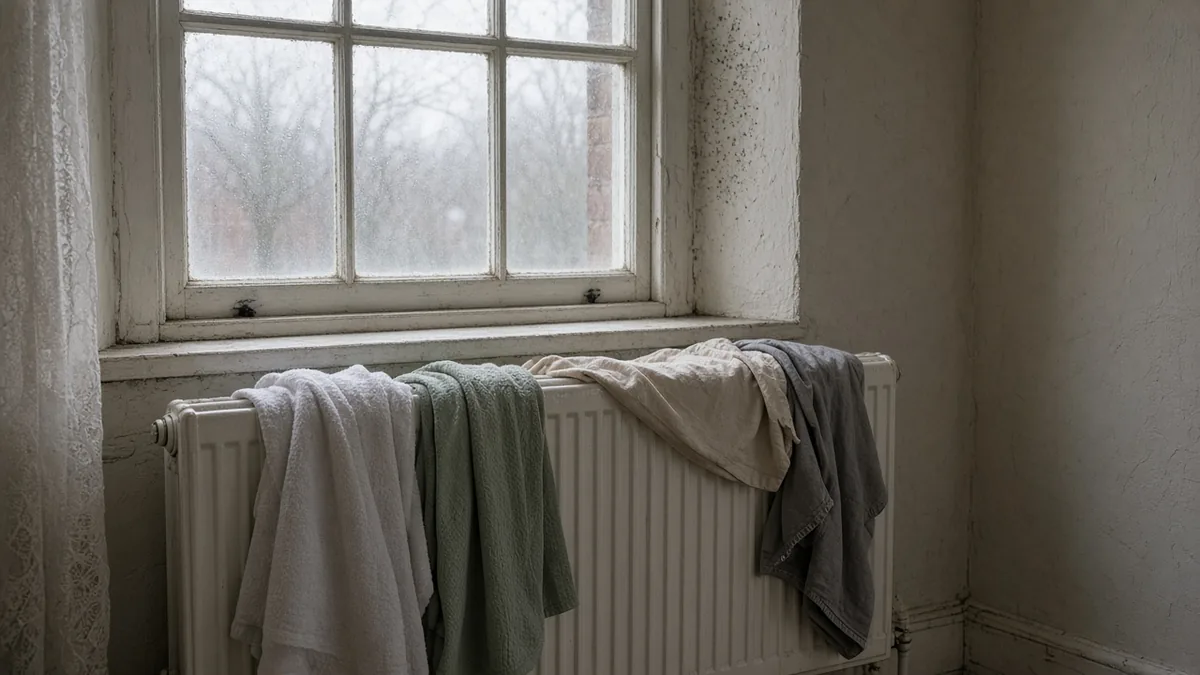
Every drop of water in a wash load ends up in your room's air, and draping it on a radiator simply speeds that up while blocking the heat the radiator is meant to circulate. NHBC estimates indoor drying can add 160 to 550 litres of moisture a year to a household, which settles as condensation on cold walls and windows and feeds black mould. Dry on an airer in one closed, ventilated room, ideally with a dehumidifier running (about 4p an hour for a 151 W model at the current Ofgem cap).
Draping jeans and towels over the radiators is the default drying method in thousands of British flats and terraces from October to March. It feels efficient: the heating is on anyway, and the clothes are dry by morning. The problem is what happens to the water. This guide follows a wash load from the drum to your bedroom wall, explains why housing bodies are so consistent in telling people not to do it, and sets out the alternatives that keep both the bills and the mould down.
Where the Water Goes
A wet wash load does not lose its water by magic. Whatever the spin cycle leaves behind evaporates into the room you dry it in, and from there it spreads into the rest of the home.
The amounts are not trivial. The NHBC Foundation's guide Moisture in New Homes compares typical households. A retired couple drying washing indoors on racks or radiators adds an estimated 160 litres of moisture a year from laundry alone; a family of four with two teenagers doing the same adds about 550 litres. Households that tumble dry or dry outdoors score zero in that column. Hartlepool Borough Council's damp booklet puts indoor drying at 10 to 15 litres a week.
Warm air can hold more water vapour than cold air. When that moist air drifts into a cooler bedroom or touches an outside wall, it cools, can no longer hold all its vapour, and the excess forms condensation. NHBC's guidance note Condensation in your home lists the usual landing spots: windows, the colder parts of walls, around window and door openings, where ceilings and floors meet outside walls, inside cupboards and behind furniture against an outside wall. "If condensation keeps occurring in the same place, it can sometimes cause black mould to grow."
Why the Radiator Makes It Worse
Drying on an airer releases the same water eventually, so why single out radiators?
It blocks the heat you are paying for
A radiator warms a room mainly by convection: air heated at its surface rises and circulates, pulling cooler air in behind it. The charity Groundwork explains that drying clothes on a radiator "gets in the way of that airflow, meaning it requires more energy to heat the room", which puts more pressure on the boiler. Jon Phillips of boiler manufacturer Baxi told This is Money the same thing: the clothes "can prevent heat from being released, so your boiler uses more energy (and money) to keep the whole room warm".
Hartlepool Borough Council's booklet is blunter still, saying drying clothes on radiators will make your boiler work harder "and cost almost as much as using a tumble dryer, whilst creating a lot of condensation". We have not been able to verify that comparison independently, and it will vary by boiler and tariff, but the direction of travel is clear.
It releases the water fast, in one go
A radiator pushes moisture out of the fabric quickly. That is the appeal, but it also means a burst of vapour enters the air over a few hours, typically in the evening when windows are shut and the house is cooling down overnight. The coldest surfaces in the home, often a bedroom window or the north-facing wall behind a wardrobe, are where it ends up.
It is usually done in the wrong room
Radiator drying tends to happen wherever there is a free radiator: the living room, the hallway, a child's bedroom. NHBC's advice is the opposite: if you must dry indoors, open the window and close the door of the room where the clothes are drying, so the moisture escapes outside rather than spreading through the house. Both NHBC guides tell occupants to avoid drying clothes on radiators where possible.
Why This Leads to Black Mould
Black mould is the visible end of repeated condensation, not the start. The government's guidance Understanding and addressing the health risks of damp and mould in the home describes condensation damp as moisture generated inside the home that "cools and condenses onto colder parts of the buildings (for example window frames, corners and low points on walls behind sofas or wardrobes)", and calls it the most common form of damp. It lists drying laundry outdoors where possible among the everyday steps landlords should explain to tenants.
That guidance is also clear on health: damp and mould mainly affect the airways and lungs, and while everyone is vulnerable, people with health conditions, children and older adults face the greatest risk. NHS inform lists respiratory problems, infections, allergies and asthma among the effects.
One important caveat if you rent: laundry is rarely the whole story. Government guidance warns that approaches which attach blame to occupants' behaviour are "unjust and counterproductive", and a home with broken extractor fans, missing trickle vents or cold bridging will struggle however the washing is dried. Our Awaab's Law guide covers what landlords must do.
Better Ways to Dry Clothes Indoors
1. Get more water out before it leaves the drum
Groundwork recommends using the highest spin your clothes can take and adding an extra spin if needed. Every bit of water removed in the machine is water that never reaches your walls.
2. Use an airer in one closed, ventilated room
Pick one room, ideally a bathroom with an extractor fan or a room with an openable window, close the door and keep a window or trickle vent open. The Energy Saving Trust's ventilation advice specifically says to open windows to boost ventilation when you are drying clothes on a rack indoors. Don't overload the airer: Groundwork notes that crowded clothes take longer to dry.
3. Add a dehumidifier to capture the water
The Energy Saving Trust suggests considering a dehumidifier to help with drying washing inside. Instead of the moisture settling on your windows, it ends up in a tank you pour down the sink. Run it in the closed drying room, close to (not touching) the airer.
4. A heated airer if you need speed
The Energy Saving Trust's Energy Savers Week tips recommend a heated airer over a tumble dryer as cheaper to run and quicker than a standard airer, with the reminder to keep trickle vents or a window open. A heated airer still puts all the water into the room, so pair it with ventilation or a dehumidifier. Our heated airer vs dehumidifier vs tumble dryer comparison goes through the options in detail.
What It Costs to Run the Alternatives
Using the Ofgem price cap unit rate of 26.32p/kWh for 1 October to 31 December 2026 (Ofgem) and the wattages in our product dataset:
| Appliance | Power | Cost per hour | 8-hour drying session | Price on Amazon UK |
|---|---|---|---|---|
| MeacoDry Arete One 12L (laundry mode) | 151 W | 3.97p | £0.32 | £179.99 |
| Pro Breeze OmniDry 12L (laundry mode) | 200 W | 5.26p | £0.42 | £118.99 |
| Status 230W Heated Winged Airer | 230 W | 6.05p | £0.48 | £38.24 |
Swipe to see more columns
Price accurate as of 29/11/2026 06:23 GMT. Running costs are calculated from the stated wattage at full power; a dehumidifier that reaches its humidity target will cycle off and use less. Ofgem has announced a higher cap for 1 January to 31 March 2027, so these figures will rise in the new year; see our running cost guide.
For a broader shortlist, see the best dehumidifiers for drying clothes indoors.
Check the Effect With a Hygrometer
A cheap digital hygrometer turns guesswork into numbers. Put one such as the Govee H5075 (£9.48 at the time of checking) in the room you dry washing in and another in the coldest bedroom. If readings climb well above the 40–60% band on drying days and windows are streaming in the morning, the laundry is overwhelming your ventilation. Our ideal indoor humidity chart explains what each reading band means.
A Simple Winter Laundry Routine
- Spin on the highest setting the fabric allows.
- Hang on an airer, not a radiator, with space between items.
- Use one room: door closed, window or trickle vent open, extractor fan on if it has one.
- Run a dehumidifier in laundry mode in that room, or at least open the window for a few minutes several times a day.
- Wipe any condensation off windows each morning.
- Keep radiators clear so the heating can do its job.
The Bottom Line
Drying clothes on a radiator does not make the water disappear; it puts it into your air faster while stopping the radiator from heating the room properly. Repeated every day, that water condenses on cold walls and windows and gives black mould the conditions it needs. An airer in one closed, ventilated room, ideally with a dehumidifier collecting the water for a few pence an hour, gets the same washing dry without the damp.
Recommended In-Stock Models & Running Costs
Only models currently in stock on Amazon UK are shown below. Adjust the electricity rate to match your tariff.
| Model | Category | Power | Cost / hr | 8h Cycle | Amazon UK Price | Action |
|---|---|---|---|---|---|---|

Meaco MeacoDry Arete One 12L Dehumidifier / Air Purifier
12L/day
·
35 dB
|
Compressors | 151 W | 3.97p/hr | £0.32 |
£179.99
Price accurate as of 29/11/2026 06:23 GMT
|
Check price on Amazon |

Pro Breeze OmniDry 12L Quiet Dehumidifier with Max Extraction
12L/day
·
36 dB
|
Compressors | 200 W | 5.26p/hr | £0.42 |
£118.99
Price accurate as of 29/11/2026 06:23 GMT
|
Check price on Amazon |
| Heated Airers | 230 W | 6.05p/hr | £0.48 |
£38.24
Price accurate as of 29/11/2026 06:23 GMT
|
Check price on Amazon | |
| Hygrometers | — | — | — |
£9.48
Price accurate as of 29/11/2026 06:23 GMT
|
Check price on Amazon |


Product prices and availability are accurate as of the date/time indicated and are subject to change. Any price and availability information displayed on Amazon.co.uk at the time of purchase will apply to the purchase of this product.
Frequently Asked Questions
Is it really that bad to dry clothes on a radiator now and then?
An occasional item is not going to ruin a house, but the moisture still has to go somewhere. Every litre of water the spin cycle leaves in the fabric evaporates into the room. If it happens most days in winter, with windows shut, that water condenses on the coldest surfaces, and repeated condensation is what lets black mould take hold.
Does drying clothes on radiators make my heating bill higher?
Advice from boiler maker Baxi, quoted by This is Money, and from the charity Groundwork says yes: wet clothes stop the radiator's warm air rising and circulating, so the boiler has to work harder to warm the room. Hartlepool Borough Council goes further and says it can cost almost as much as a tumble dryer. The exact cost depends on your boiler, tariff and how much washing you dry.
What is the cheapest way to dry clothes indoors without causing condensation?
An unheated airer in a room with the door closed and a window or trickle vent open costs nothing to run. Adding a compressor dehumidifier speeds things up and captures the water instead of letting it settle: a 151 W model costs about 3.97p per hour at the Ofgem cap of 26.32p/kWh (1 October to 31 December 2026).
Is a heated airer better than a radiator?
It still releases all the water into the room, so you still need ventilation or a dehumidifier. The advantage is that it does not block your central heating. The Energy Saving Trust suggests a heated airer instead of a tumble dryer as long as you keep trickle vents or a window open.
More UK Damp & Running-Cost Guides
Protecting Power Tools, Bikes and Classic Cars From Rust in a UK Garage
Rust in a garage comes from condensation on metal that is colder than the surrounding air, so the fix is drier air, not more ventilation. Meaco advises a well-sealed garage with a dehumidifier set to about 50% RH; in an unheated UK garage that usually means a desiccant model, which works down to 1°C. An EcoAir DD1 Simple costs about 7.90p an hour on its low setting at the current Ofgem cap, and should be set up with continuous drainage and its humidistat so it can run unattended.
Should You Leave Window Trickle Vents Open All Winter in the UK?
Yes. GOV.UK's ventilation guide and the Energy Saving Trust both say to keep trickle vents open and unblocked all year, including winter: you use a little more heating energy, but you get a constant, controlled supply of fresh air that carries moisture out before it condenses. Close them only briefly, for example when outdoor pollution or smoke is high, and reopen them afterwards.
Stopping Green and Black Mould Behind Wardrobes Against External Walls
Mould behind a wardrobe is almost always condensation: the outside wall is cold, the furniture stops warm air reaching it, and moist bedroom air condenses in the still gap. Move the wardrobe to an internal wall if you can; if not, leave a gap of at least 75–100 mm (City of London and Chesterfield council advice), don't overfill it, and keep bedroom humidity in the 40–60% band with ventilation, steady heating and, if needed, a quiet dehumidifier.